Last updated on 12/28/25 | First published on 7/16/20 | Literature review current through Aug. 2026
[cite]
Authors:
Erin M. Tharalson DNP, RN, ANP-BC, CWS ,
Elaine Horibe Song MD, PhD, MBA,
more...
Coauthor(s)
Elaine Horibe Song, MD, PhD, MBACo-Founder and Editor, Wound Reference, Inc;
Professor (Affiliate), Division of Plastic Surgery, Federal University of Sao Paulo;
Volunteer, Association for the Advancement of Wound Care;
Google Scholar Profile
Disclosures: Nothing to disclose
Erin M. Tharalson, DNP, RN, ANP-BC, CWS
Disclosures: Nothing to disclose
Editors
For full access to this topic and more
premium content, upgrade today. Or get started with a Free Basic account (limited content and tools).
Summary
If you cannot physically make a trip to the clinic or if you need to limit trips to your clinician's office, live real-time televisits (also known as video visits, telehealth encounter) are a convenient way to ensure your clinician continues to deliver the care you need, when you need it. During a televisit, your clinician will be able to see your wounds and discuss a care plan with you. Televisits can also be facilitated by another clinician who will be next to you during the televisit.
This topic provides tips for patients on how to have a successful wound care televisit, and on how patients can help remote wound clinicians assess wounds during the televisit. See handouts "PRO Tips For A Great TeleVisit", "TeleVisit Pre-Video Call Self-Wound Check" and "Getting Started with TeleVisit Tool 2.0" (How to check-in and how to submit photos to your clinician)
PRO Tips For A Great TeleVisit | TeleVisit Pre-Video Call Self-Wound Check | Getting Started for Clients - TeleVisit Tool 2.0.
|
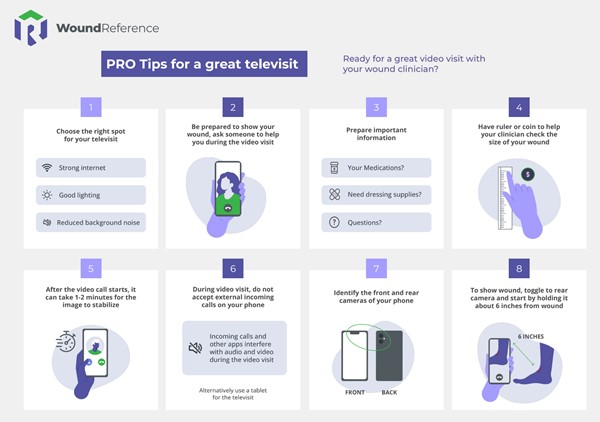
PRO Tips For A Great TeleVisit
This brochure is indicated for all patients and facilitating clinicians who would like to participate in a wound care-specific televisit. View the handout to answer questions such as:
- How do I get prepared for a wound care TeleVisit?
- How is a wound care televisit different from other televisits?
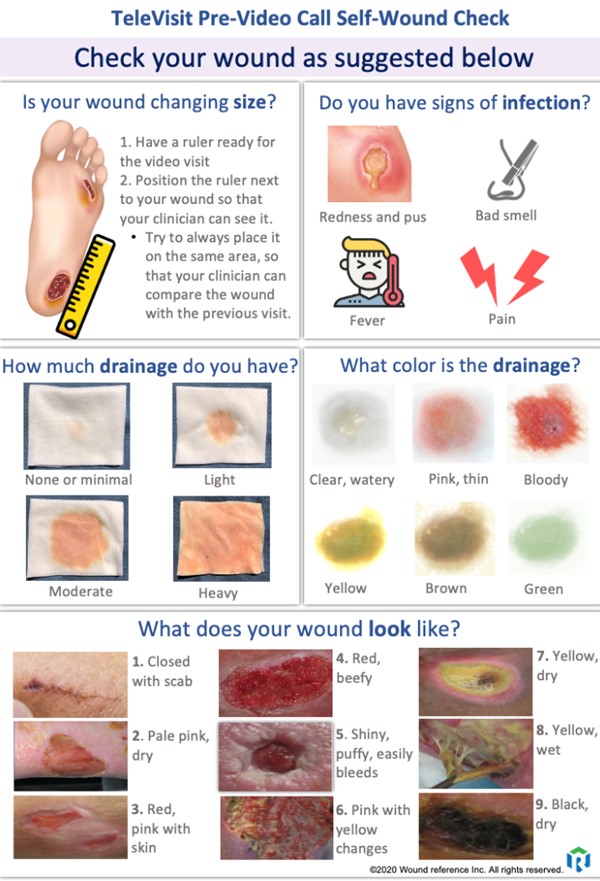
TeleVisit Pre-Video Call Self-Wound Check
This handout provides steps for you to help your clinician better assess your wounds during televisits. View the handout to answer questions such as:
- Is my wound changing its size?
- Do I have signs of infection?
- How do I describe my wound?
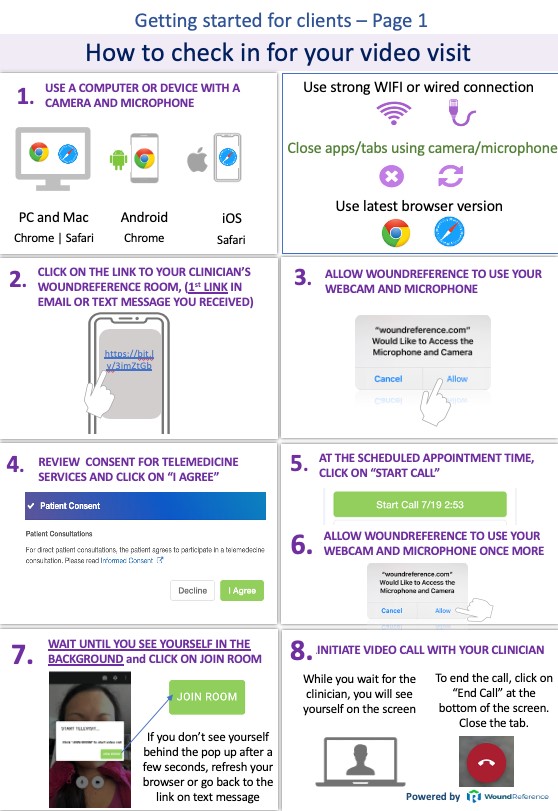
TeleVisit Tool 2.0. - Getting Started for Clients
If you provider is using WoundReference TeleVisit 2.0. to see you remotely, please follow these easy step-by-step brochures to:
- Check-in for your visit
- Submit files and photos to your clinician
Official reprint from WoundReference® woundreference.com ©2026 Wound Reference, Inc. All Rights Reserved
Use of WoundReference is subject to the
Subscription and License Agreement.
NOTE: This is a controlled document. This document is not a substitute for proper training, experience, and exercising of professional judgment. While every effort has been made to ensure the accuracy of the contents, neither the authors nor the Wound Reference, Inc. give any guarantee as to the accuracy of the information contained in them nor accept any liability, with respect to loss, damage, injury or expense arising from any such errors or omissions in the contents of the work.
Patient Education Topic and Wound Poster: these resources help clinicians explain to patients how wounds heal, how to recognize infection, and what patients can do to help their wound heal. The poster may be printed out, shared with patients and/or displayed at healthcare facilities.
