Increasing patient volume in a hyperbaric medicine clinic requires a multifaceted strategy beyond advertising. The most effective approach involves establishing a reliable patient-referral pipeline, enhancing access and conversion rates, educating referring clinicians about appropriate hyperbaric oxygen therapy (HBOT) indications, and streamlining clinic processes for both patients and providers.
The primary objective is to achieve appropriate patient growth, rather than increasing treatment volume without clinical justification. Hyperbaric therapy must remain grounded in accepted clinical indications, medical necessity, patient safety, and compliance with applicable payer requirements.
The goal is to establish the clinic as a timely, responsive, and clinically trusted destination for HBOT evaluation. When these five elements are consistently implemented and measured, the clinic can increase patient volume while maintaining appropriate patient selection, high-quality care, and regulatory compliance.
GROWTH STRATEGY FOR HBOT PROGRAMS
1. Increasing Awareness Among Referring Providers and the Community
Build a Strong Referral Network
A significant opportunity for hyperbaric programs lies in establishing a systematic referral strategy. Rather than trying to reach all doctors indiscriminately, clinics should focus on specialties and the individual providers most likely to encounter patients who may benefit from HBOT.
Potential referral partners include wound care clinicians and wound centers, podiatrists, plastic and reconstructive surgeons, hospitalists, primary care clinicians, radiation oncologists, oral and maxillofacial surgeons, infectious disease specialists, and vascular specialists.
Enhance Collaboration with Wound-Care Programs
Wound-care programs represent a significant source of appropriately referred patients for HBOT.[1] It is recommended that HBOT programs establish collaborative relationships with the following entities:
- Hospital-based wound-care centers
- Outpatient wound-care clinics
- Podiatric practices
- Home health-care organizations
- Skilled nursing facilities
- Diabetes-focused clinical practices
HBOT programs should offer educational resources that outline the indications for HBOT evaluation and establish consistent communication channels with wound-care providers.
- A key opportunity involves identifying patients whose wounds do not heal as anticipated with conventional care and determining whether they meet criteria for HBOT evaluation.
Provide Educational Opportunities for Referring Providers and Wound Care Teams
Many physicians and providers are familiar with HBOT but may not know the full range of accepted indications, or referral criteria. Provider education should be a central part of the HBOT program's growth strategy.
- Useful approaches include brief in-office presentations, grand rounds, wound-care conferences, continuing medical education programs, and one-page indication/referral guides. For printable provider education materials, refer to the 'Outreach' tab in the "Hyperbaric Oxygen Therapy - Knowledge Base".
- Direct conversations from the medical director, physician or provider should focus on clinical and educational content rather than promotional messaging. This approach positions the clinic as a valuable clinical resource for referring providers.
Help Referring Providers and Wound Care Teams Identify HBOT Candidates
HBOT is not indicated or appropriate for every patient. Each clinical indication requires specific criteria, which must be clearly documented to establish medical necessity.
Strategies for early identification of HBOT candidates include:
- Implementation of an HBOT screening trigger within the wound clinic or referring provider's office, instead of relying solely on the referring provider to consider HBOT.
- For example: a diabetic foot wound combined with chronic or nonhealing status and appropriate severity should prompt HBOT screening.
- Nurses and the clinical team play a critical role in identifying patients who may not initially meet criteria for a specific indication during evaluation or early care planning, but who may become eligible if their condition deteriorates or plateaus.
Strengthen Your Referring Provider Outreach Program
Outreach to potential referring providers should be systematic rather than occasional. Create a list of target providers and divide them into tiers:
- High-potential referral sources: Providers who routinely encounter patients with conditions potentially appropriate for HBOT.
- Moderate-potential sources: Providers who encounter these patients occasionally.
- Awareness-building sources: Providers who may refer less frequently but should know the clinic exists.
This approach transforms provider outreach into a measurable business development process rather than an informal marketing activity.
Metrics to Track:
- Number of providers contacted
- Number of visits
- Referrals generated
- Evaluations generated
- Treatments initiated
- Referrals by indication
- Referrals by provider
Increase Community Awareness and Patient Understanding of HBOT
Community and patient education is important in raising awareness of the need for appropriate referrals for HBOT and in helping patients know when HBOT might be a suitable part of their wound care treatment plan. Efforts in this area are best directed at patients and the wider community, covering primary care providers, diabetes programs, home health agencies, and other healthcare organizations that frequently come across patients with complicated or non-healing wounds.
- By providing clear information on the kinds of wounds that could benefit from HBOT, the importance of making an early referral, and the role of HBOT as an adjunct - rather than a replacement - for comprehensive wound care, the appropriate candidates can be better identified.
- For patients, education can help clarify misconceptions and reduce anxiety about HBOT, lead to greater acceptance and adherence to treatment, and stress the importance of finishing the prescribed course of treatment.[2]
Having a consistent strategy for community education increases awareness of the programs and helps make sure that referrals are made to patients most likely to satisfy both clinical and payer criteria.
Potential community outreach activities include:
- Community health events
- Wound-care education
- Educational materials for caregivers
- Partnerships with appropriate community organizations
- Educational videos explaining HBOT
The goal is to help patients recognize when they should ask their provider whether an HBOT evaluation is appropriate.
2. Increasing Appropriate Referrals
Develop Indication-Specific Referral Pathways
A simple, efficient referral process encourages provider participation and facilitates timely access to HBOT evaluation. Referring providers need a quick way to initiate a referral, with only the essential information required for an initial review. Promptly responding to every referral - including when the patient does not meet clinical or coverage criteria - reinforces trust and helps maintain the referral relationship.
For each major HBOT indication, establish a standardized referral pathway that defines:
- Referral triggers and eligibility criteria
- Required clinical documentation and diagnostic testing
- Referral contacts and submission procedures
- Expected response and consultation timeframes
- Medical necessity and payer authorization requirements
- Responsibilities for treatment coordination and follow-up
A typical pathway may be structured as follows (Figure 1):
- Potential candidate →
- referring provider →
- hyperbaric medicine evaluation →
- medical necessity and coverage review →
- treatment, when indicated →
- ongoing communication with the referring provider
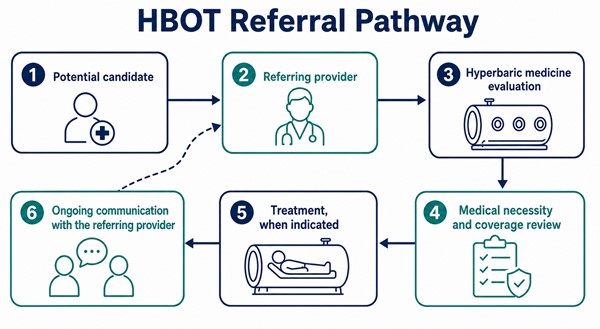
Fig. 1. HBOT Referral Pathway
Establish a Referral and Feedback Communication Loop
Direct physician-to-physician and provider-to-provider communication is a key factor in establishing and maintaining strong referral relationships.[3] Referral sources are more likely to continue sending appropriate patients when they know the receiving provider is accessible, responsive, and involved in the patient's care.[4]
- Timely communication about the referral, clinical evaluation, treatment recommendations, progress, and outcomes shows that the referral is valued and the patient is receiving coordinated care.
- When HBOT is not recommended, explaining the clinical rationale and suggesting alternative next steps, when appropriate, can still provide value to the referring provider and patient.
- Updates may take the form of a brief telephone call, secure electronic message, consultation note, or written progress report.
- Closing the feedback loop demonstrates that the referral is valued, strengthens continuity of care, and positions the hyperbaric medicine program as a trusted clinical partner rather than simply a destination for referrals.
3. Improving Referral-to-Treatment Conversion
Increasing referrals addresses only part of the challenge. The HBOT program must also consistently convert suitable referrals into completed evaluations and, when appropriate, HBOT treatments.
Tracking the entire patient journey is essential to identify where patients are lost. This should begin from the time a referral is received to when treatment is finished (see Figure 1).
By setting goals for each step, you can spot where patients are dropping out and find ways to improve operations and increase patient numbers without needing more referrals.
Analyze where patients are being lost. For example:
- Are referrals not being contacted quickly?
- Are patients unable to reach the clinic?
- Are appointments scheduled too far out?
- Are patients being screened for potential HBOT?
- Are insurance requirements creating delays?
- Are patients receiving inadequate education about the treatment process?
- Are transportation or scheduling issues preventing treatment?
- Are patient appointments being rescheduled due to provider availability?
Estimate the Potential HBOT-Eligible Population Among Patients With Chronic Wounds
What is the percent of wound clinic patients that qualify for hyperbaric oxygen therapy? No single published percentage applies to every wound clinic because it depends on the clinic’s patient mix, referral patterns, and payer requirements. But for planning a wound clinic and HBOT program, a reasonable working estimate based on authors' experience is shown in Table 1.
Table 1. Estimating the Potential HBOT-Eligible Population Among Patients With Chronic Wounds
| Wound clinic population | Approximate % potentially qualifying for HBOT |
| All wound clinic patients | 5–15% |
| Diabetic foot ulcer patients | 10–25% |
| Wagner Grade 3–4 DFU patients | Higher - potentially 50%+, depending on failure of standard care |
The most defensible benchmark comes from a large diabetic-foot-ulcer study where 19.3% of wounds were Wagner Grade ≥3, while 12.7% of subjects received HBOT.[5] The key point is that "qualifies" is not the same as "receives HBOT."
For Medicare coverage of HBOT for diabetic wounds of the lower extremities, documentation must establish that [6][7][8]:
- The patient has type 1 or type 2 diabetes and a lower-extremity wound attributable to diabetes
- The wound is classified as Wagner Grade 3 or higher
- The wound has failed an adequate course of standard wound care, defined as no measurable signs of healing for at least 30 consecutive days.
Example: Estimating the HBOT business opportunity from an existing wound clinic
To estimate the HBOT business opportunity from an existing wound clinic, one may use 10% as a starting assumption and model 10–15% of wound patients as potential HBOT candidates.[2]
For example:
- 500 wound patients/year → 50–75 potential HBOT patients
- 1,000/year → 100–150
- 2,000/year → 200–300
- 3,000/year → 300–450
NOTE: differentiate new wound patients versus wound visits. Calculate this from unique wound patients, not the number of wound-care encounters.
Implement and Track Conversion Metrics
Consider the following metrics to be reviewed monthly by referral source, provider, diagnosis, payer, and evaluating provider.
- Referral-to-evaluation conversion: Percentage of referrals resulting in a completed evaluation.
- Evaluation-to-HBOT conversion: Percentage of completed evaluations resulting in an HBOT treatment recommendation.[9]
- Recommendation-to-treatment conversion: Percentage of recommended patients who actually begin treatment.[10]
- Referral-to-treatment conversion: The overall percentage of referrals that ultimately become HBOT patients.
- Referral leakage: Percentage of referrals lost because of inability to contact the patient, scheduling delays, insurance barriers, transportation issues, clinical ineligibility, or patient refusal.[11]
- Monitoring "HBOT referral leakage" represents a critical performance metric. If a clinic evaluates 1,000 wound patients and only 15 receive HBOT, it cannot be assumed that demand for HBOT is low.[12]
- Time to evaluation: Average number of days from referral receipt to completed evaluation.[13]
- Time to first treatment: Average number of days from referral receipt to the patient's first HBOT treatment.
The objective is not to maximize every conversion rate regardless of clinical appropriateness, but rather to minimize avoidable leakage while maintaining appropriate clinical criteria.
- A clinic that increases referral volume by 20% but allows scheduling, authorization, or patient-contact problems to rise may see little growth in actual HBOT treatments.
- Conversely, improving the conversion process can increase chamber utilization and revenue from the same referral base.
Eliminating these barriers can lead to significant patient growth without needing additional referrals.
Focus on Hyperbaric Chamber Utilization
Increasing patient volume does not necessarily require purchasing another chamber. Improving utilization can increase throughput before capital expenditures are necessary.
First determine whether existing capacity is being fully utilized. For example, a clinic might have adequate theoretical capacity but low utilization because of:
- Lack of provider coverage
- Gaps between treatment schedules
- Cancellations
- No-shows
- Limited operating hours
- Poor scheduling practices
- Referral bottlenecks
4. Improving Patient Access and Experience
A positive experience with HBOT depends on several factors, including friendly, responsive staff; clear expectations established before the initial treatment; a comfortable treatment environment; reliable scheduling with minimal wait times; and consistent communication. Additionally, patients benefit from easy access to staff when issues arise, clear instructions regarding treatment preparation, and regular communication with the referring physician. Given that HBOT typically requires multiple visits, even minor operational issues may present significant barriers to treatment completion.
Improve Scheduling Convenience and Appointment Access
HBOT frequently requires a series of treatments, making convenience especially important.
Consider:
- Early-morning treatment slots
- Evening availability when practical
- Reserved evaluation slots for new referrals
- Rapid-access appointments
- Efficient scheduling of treatment course
- Waitlist management
- Same-week evaluation opportunities when clinically appropriate
Educate Patients
It is important to provide patient education if HBOT is to be given safely. When patients are well informed about the purpose of the treatment, what the process involves, and what results they can expect, they are more likely to feel at ease and become actively involved in their treatment. The HBOT program should ensure that patients clearly understand the following aspects:
- How many treatments may be required?
- How long each visit takes
- What the treatment experience is like
- What they need to do before treatment
- What their insurance may require
- Who they can contact with questions
Giving patients thorough education helps to lessen their anxiety, encourages them to follow the treatment protocols, and allows them to take an active role in their care. As a result, good patient education not only improves satisfaction and the outcomes of treatment but also reduces the chances of misunderstandings or non-compliance. Patients who fully understand the treatment commitment are more likely to complete the prescribed plan.
5. Monitoring Performance and Driving Continuous Improvement
Maintain a Growth Dashboard
A hyperbaric program should implement a concise monthly growth dashboard to monitor performance and inform decision-making. The dashboard should include [14]:
- Referral metrics: Total referrals, referrals by physician, specialty, indication, new referring physicians, and repeat referring physicians.
- Conversion metrics: Referral-to-contact rate, contact-to-evaluation rate, evaluation-to-treatment rate, average days from referral to evaluation, and average days from evaluation to treatment.
- Treatment metrics: Record treatments initiated, treatments completed, average treatments per patient, cancellation rate, no-show rate, and treatment utilization by chamber.
- Operational metrics: Payer mix, authorization delays, denial rate, chamber utilization, and staff utilization.
The template Hyperbaric Treatment Growth, Activity and Referral Dashboard below helps the HBOT program identify strengths, address deficiencies, and promote sustained growth.[14]
- Hyperbaric Treatment Growth, Activity and Referral Dashboard
Implement a 90-day Referral Growth Plan As Needed
90-day referral growth plan that includes specific actions for each stage, with an emphasis on analyzing present performance, carrying out targeted outreach, and improving the results.
Analyze and Prepare
- Establish baseline referral and treatment metrics to understand current performance.
- Identify top referral sources and underperforming referral channels.
- Review the referral workflow and measure the time from referral to evaluation.
- Audit the website and referral materials to ensure they are current and effective.
- Identify scheduling bottlenecks that delay patient care.
Launch Outreach
- Visit high-potential physician practices to build relationships and encourage referrals.
- Meet with wound-care teams to expand referral opportunities.
- Provide concise clinical education to referral sources.
- Distribute updated referral information and materials.
- Establish a rapid referral process to streamline patient access.
- Improve patient follow-up after referrals to enhance satisfaction and retention.
Optimize
- Measure the number of new referrals generated during outreach efforts.
- Analyze which outreach activities were most effective in generating referrals.
- Re-engage with high-performing providers to maintain strong referral pipelines.
- Address referral leakage by identifying and fixing gaps in the process.
- Work to reduce appointment delays, cancellations, and no-shows.
- Adjust outreach strategies based on actual results and feedback to maximize impact.
